Dr Manuel Fernández Cano Launches tresD DICOM: A Browser-Based Solution for Dental Imaging and Clinical Visualization

Dr. Manuel Fernández Cano, a practicing orthodontist at Clínica Áncora in Málaga, Spain, has officially launched tresD DICOM, an innovative, free-to-use web-based platform designed to transform how dental clinicians access, visualize, and analyze complex patient imaging files. By removing the traditional barriers of proprietary software installations and restrictive hardware requirements, the platform allows practitioners to render Digital Imaging and Communications in Medicine (DICOM) files directly within a standard web browser. This development marks a significant shift in the digital dentistry landscape, emphasizing accessibility, data privacy, and the democratization of high-end diagnostic visualization tools.
The Evolution of Dental Imaging and the "Browser-First" Paradigm
For decades, the dental profession has been tethered to cumbersome, expensive, and often proprietary software suites bundled with expensive imaging hardware. When a clinician needed to review a Cone Beam Computed Tomography (CBCT) scan, they were typically required to utilize the specific workstation where the software was licensed and installed. This architectural constraint created bottlenecks in clinical workflows, limiting the ability of practitioners to consult patient data from home offices, during multi-disciplinary team meetings, or while on the move.
The introduction of tresD DICOM addresses these logistical inefficiencies by leveraging modern web technologies, such as WebGL and WebAssembly, which allow for intensive computational tasks to be performed locally on the user’s hardware. This move toward a "browser-first" model represents a broader trend in health-tech, where the cloud—or in this case, the browser—serves as the primary interface for complex medical data management. By eliminating the need for installation, Dr. Cano has effectively removed the "compatibility friction" that often plagues dental offices utilizing equipment from multiple manufacturers.
Architecture of Privacy: Localized Data Processing
A critical concern in the digital age of healthcare is the intersection of patient data privacy and technological convenience. Many cloud-based dental imaging platforms require the upload of sensitive patient scans to a third-party server, raising significant concerns regarding HIPAA (Health Insurance Portability and Accountability Act) and GDPR (General Data Protection Regulation) compliance.
The architecture of tresD DICOM is intentionally designed to mitigate these risks through local processing. When a user drags a patient folder or a physical CD onto the interface, the platform executes the rendering process entirely within the local memory of the host device. The application does not communicate with an external server to process or store the data, ensuring that sensitive biometric and anatomical information never leaves the physical confines of the practice’s hardware.
"I wanted any colleague to be able to open their patient’s CBCT in seconds, from any computer and without the files leaving the practice," Dr. Cano stated in a release regarding the platform’s development. This design choice aligns with the growing demand for "zero-trust" software architectures in medicine, where data security is guaranteed by the fact that the data is never transmitted to the software developer.
Technical Capabilities and Clinical Utility
While the platform is positioned as a visualization and teaching tool rather than a diagnostic medical device, its technical feature set is robust. The platform is engineered to handle files from the industry’s most prominent imaging manufacturers, including Carestream, Planmeca, Sirona, Vatech, i-CAT, Morita, and NewTom.
The software’s core functionality includes:
- 3D Rendering with Custom Presets: Users can toggle between bone and soft-tissue visualization modes, allowing for a clearer understanding of anatomical structures.
- Airway Analysis: The platform provides airway heat maps, a critical feature for orthodontists and sleep specialists evaluating obstructive sleep apnea and other respiratory issues.
- Automated Image Generation: Clinicians can instantly generate panoramic and cephalometric images from raw 3D data, facilitating standard orthodontic planning.
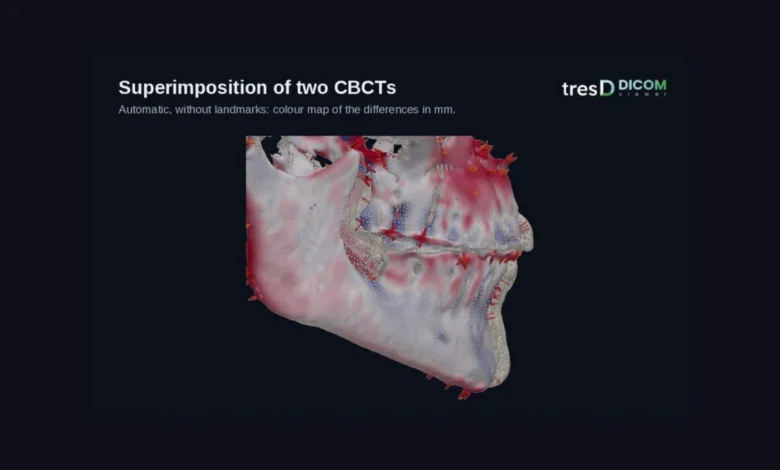
- Superimposition and Comparison: The software allows for the overlay of two distinct scans of the same patient. By color-coding the differences in millimeters, clinicians can objectively track treatment progress or anatomical changes over time.
- Multimodal Integration: Perhaps the most sophisticated feature is the ability to fuse intraoral scans with facial photos onto the 3D model, providing a comprehensive "digital twin" of the patient’s head and neck.
Expanding the Ecosystem: The Role of tresD Models
Recognizing that clinical workflow involves more than just CBCT data, Dr. Cano has expanded the platform’s reach with the introduction of "tresD Models." This companion tool is designed specifically for the management and manipulation of intraoral scans (IOS).
As dental practices increasingly adopt digital impression systems, the ability to rapidly process and refine these files has become paramount. tresD Models provides the capability for 2D sectioning and precise linear measurements. Furthermore, it includes features for creating virtual model bases, a necessary step for clinicians who intend to 3D print diagnostic models for aligner therapy or restorative planning. By creating a unified, free ecosystem, the developer has provided a streamlined path for practitioners to bridge the gap between initial digital impression and final physical appliance production.
Regulatory Context and Professional Implications
It is imperative to note that both tresD DICOM and its companion tool, tresD Models, are strictly defined as visualization and educational utilities. They have not received FDA (U.S. Food and Drug Administration) clearance nor have they been CE-marked as medical devices. Consequently, while the measurements provided are highly indicative and useful for clinical planning, they should not be considered substitutes for certified diagnostic software when making high-stakes surgical or treatment decisions.
This distinction is standard for open-source or educational tools in the medical field. The platform is not attempting to replace the high-cost, validated diagnostic software provided by equipment manufacturers. Instead, it serves as an agile, supplementary tool that allows for rapid communication, patient education, and preliminary review. By lowering the barrier to entry, it invites a wider demographic of practitioners—including those in resource-constrained environments—to engage with advanced 3D diagnostic workflows.
Industry Impact and Future Outlook
The launch of tresD DICOM arrives at a time when the dental industry is grappling with the complexities of "data silos." As more practices adopt digital workflows, the inability to move data between platforms often leads to inefficiency. By providing a universal, browser-based viewer, Dr. Cano has effectively created a common language for dental imaging, regardless of the brand of the hardware used to capture the initial data.
The impact of this tool on dental education is likely to be significant. Dental schools and post-graduate residency programs frequently struggle with the cost of licensing imaging software for students. Providing a free, high-performance, browser-based viewer allows students to practice the fundamentals of CBCT analysis and 3D treatment planning without the need for expensive laboratory workstations.
Looking forward, the success of platforms like tresD DICOM will likely depend on the continued adoption of open-source standards in medical imaging. As practitioners become more comfortable with web-based visualization, the pressure on major imaging manufacturers to provide more open, interoperable, and browser-accessible software will only intensify.
Dr. Cano’s initiative represents a grassroots movement within the dental profession—one that prioritizes clinical agility, patient data sovereignty, and the removal of artificial technological barriers. By placing these tools in the hands of the clinician for free, the project empowers practitioners to make better-informed decisions, ultimately improving the standard of care for patients across the globe. As digital dentistry continues to evolve, the ability to access and manipulate data with such ease will likely transition from an "innovation" to a standard expectation within the modern dental office.