The Evolution of Orthodontic Digital Planning
For decades, orthodontic treatment planning relied heavily on manual cephalometric analysis, plaster models, and the subjective clinical experience of the practitioner. While digital dentistry has revolutionized the field through 3D scanning and CAD/CAM fabrication, the actual decision-making process—determining the optimal path for tooth movement—has remained labor-intensive.
SoftSmile’s entry into the market was predicated on the idea that the "black box" nature of many aligner manufacturers’ proprietary planning software limited the doctor’s control. By building an open, browser-based ecosystem, the company empowered clinicians to retain ownership of the treatment plan. The launch of Vision Forecast marks the next logical step in this evolution, moving from mere "digital execution" to "predictive analytics."
The chronology of this development reflects SoftSmile’s broader trajectory. Since its founding, the company has prioritized building a robust clinical database. With over 1,000 active practitioners utilizing the VISION platform and a production volume exceeding 10,000 treatment plans per month, the company has amassed a significant data set. Vision Forecast leverages this historical data to create a predictive model, effectively bridging the gap between raw patient data and clinical intuition.
Mechanics of AI-Powered Case Assessment
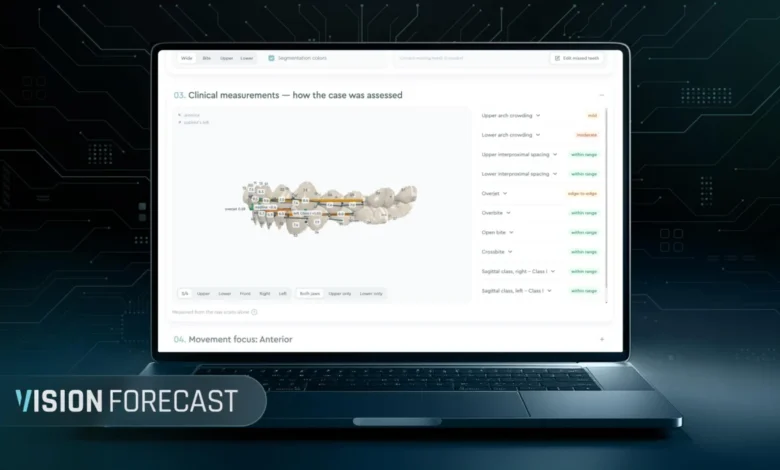
The technical architecture of Vision Forecast is designed to function as an intelligent assistant during the initial triage of a patient case. When a clinician uploads a patient’s intraoral scans and dental records, the module initiates an automated analysis. This process results in a comprehensive case summary that highlights essential metrics, including predicted aligner counts, anatomical constraints, and potential clinical risks.
One of the most significant features of this module is its ability to simulate multiple clinical scenarios. For example, a clinician can compare a treatment plan that involves premolar extractions against a non-extraction protocol involving interproximal reduction (IPR). The software calculates the projected duration for both, allowing the orthodontist to discuss the trade-offs—such as treatment length, facial aesthetics, and long-term stability—with the patient during the very first consultation.
The underlying AI identifies patterns and morphological connections that may elude even the most seasoned practitioner. By scanning the geometry of the patient’s dentition against thousands of successfully completed cases within the SoftSmile database, the system highlights "analogous cases." This feature provides the orthodontist with a blueprint of how similar malocclusions were resolved in the past, offering a data-backed foundation for their current clinical strategy.
Bridging the Patient-Doctor Communication Gap
A perennial challenge in orthodontics is managing patient expectations. Often, patients enter a consultation with a vision of their "ideal smile" but may lack an understanding of the physiological constraints or the necessary time commitment. Vision Forecast serves as a visual bridge, transforming technical data into patient-friendly insights.
"Now, the initial assessment will be visualized, and the doctor will be able to walk the patient through it," explains Khamzat Asabaev, founder and chief executive officer of SoftSmile. "This gives patients a clearer picture of what their treatment may involve, helping them understand the commitment before deciding how to proceed. Most importantly, and this is what I love most about Forecast, we will show doctors similar cases and how they were treated."
By utilizing the VISION Portal’s visualization tools, doctors can present a 3D simulation that evolves based on the chosen treatment strategy. This transparency not only helps in patient education but also builds trust. When a patient sees empirical data supporting a recommended treatment plan—and can see the projected timeline—they are statistically more likely to accept the treatment plan and remain compliant throughout the duration of the therapy.
Supporting Data and Industry Implications
The broader implications of this technology touch on the efficiency of modern orthodontic practices. According to industry data, the clear aligner market has seen a CAGR of over 20% in recent years, yet the bottleneck remains the time required for treatment planning and the frequent need for "refinement" aligners due to suboptimal initial planning.
SoftSmile’s focus on increasing "first-time accuracy" through AI is a strategic move to address this inefficiency. By reducing the reliance on multiple iterations of a treatment plan, Vision Forecast aims to decrease the administrative burden on doctors and staff. Furthermore, by standardizing the assessment process, the module provides a baseline of quality that can benefit both experienced specialists and those newer to the aligner modality.
The integration of this module into the existing VISION ecosystem is seamless. Because it relies on the same cloud-based infrastructure that supports the current 10,000+ monthly plans, the barrier to adoption for current users is negligible. This indicates a focus on "value-add" updates rather than complex system overhauls, a strategy favored by modern dental technology firms to ensure high user retention.
Clinical Analysis and Future Outlook
From a clinical standpoint, the use of AI in treatment planning is no longer a futuristic concept but a standard requirement. However, the industry is currently divided between "closed" systems—where the AI operates behind a curtain and the doctor has little say in the movement algorithms—and "open" systems like SoftSmile, where the AI acts as a consultant rather than a dictator.
The Vision Forecast module appears to fall firmly in the latter category. It provides data and suggestions, but the final clinical prerogative remains with the doctor. This is crucial for professional liability and patient-specific care, as no two dental arches are identical. The ability to toggle between treatment approaches—such as expanding an arch versus proclining incisors—gives the doctor the flexibility to incorporate their unique philosophy into the digital plan.
As the orthodontic sector moves toward higher levels of automation, the role of the orthodontist is shifting from a technician who moves teeth to a diagnostician who oversees the digital strategy. Technologies like Vision Forecast enable this shift by automating the mundane aspects of planning while surfacing high-level strategic options.
Potential Challenges and Considerations
While the benefits of such an AI-driven module are evident, implementation in clinical settings is not without challenges. Data privacy remains a paramount concern; any system analyzing patient records must adhere to strict HIPAA (or international equivalent) compliance standards. SoftSmile has maintained that its security protocols are designed to handle sensitive clinical data with enterprise-grade encryption.
Additionally, there is the risk of "automation bias," where practitioners might overly rely on the AI’s suggestions without sufficiently validating them against their own clinical findings. The success of Vision Forecast will depend heavily on the continuous education of the orthodontic community regarding how to balance AI insights with traditional diagnostic wisdom.
Conclusion: A New Standard for Orthodontic Consultations
The introduction of Vision Forecast represents a pivotal development for SoftSmile and the wider orthodontic community. By blending proprietary clinical data with advanced machine learning, the module addresses the dual needs of clinical accuracy and patient transparency. As the platform continues to scale, its ability to refine its algorithms through real-world feedback will likely make it an indispensable tool for practitioners aiming to optimize their workflows.
For the orthodontic practice of the future, success will be defined by the ability to leverage digital tools that offer both speed and precision. Vision Forecast, by providing immediate insights into complex cases and facilitating clear communication with patients, aligns with the industry’s push toward a more efficient, evidence-based, and patient-centered model of care. As more practitioners adopt this technology, the data-driven approach to orthodontics will continue to set new benchmarks for what is possible in digital smile design.