The landscape of orthodontic patient care is undergoing a significant shift with the introduction of the Brace Face Kit, a specialized, at-home management system designed to address the common, often disruptive issues that arise during active orthodontic treatment. Conceived and developed by seasoned orthodontic assistants, the kit is positioned to serve as a bridge between clinical appointments, providing patients with the tools and professional-grade guidance necessary to manage minor hardware discomfort or mechanical failures without requiring an immediate, often inconvenient, emergency visit to the orthodontist’s office.
The Evolution of Orthodontic Support
For decades, the standard protocol for patients experiencing a broken bracket, a poking wire, or general oral irritation involved a phone call to the orthodontic clinic and a subsequent emergency appointment. These unscheduled visits are a recurring logistical challenge for both the patient—who may be in school or at work—and the clinical staff, whose tightly packed schedules are often disrupted by these acute needs.
The Brace Face Kit represents a proactive shift in this paradigm. By providing patients with a portable, curated set of instruments and educational resources, the developers aim to empower individuals to resolve low-acuity issues independently. This approach is rooted in the clinical experience of the product’s creators, who spent years witnessing the frustration of patients dealing with the discomfort of metal braces and the subsequent burden placed on clinical operations when those issues were left unaddressed until a scheduled visit.
Kit Contents and Technical Specifications
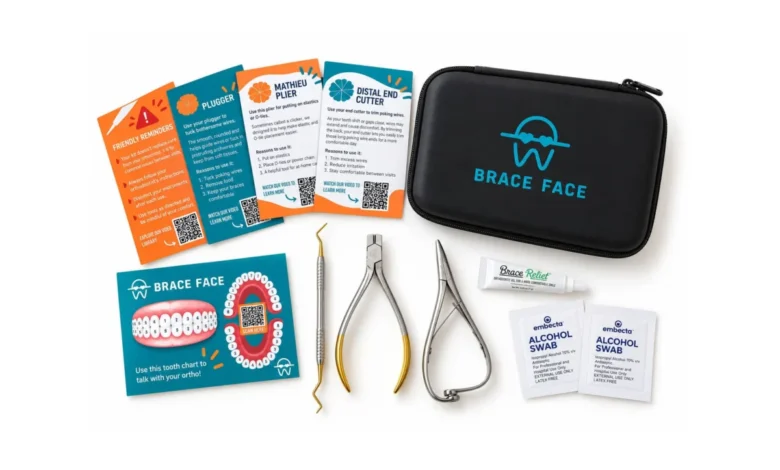
The Brace Face Kit is housed in a compact, portable storage case designed for high-frequency use, whether the patient is traveling, attending school, or participating in athletic activities. The contents are curated to replicate, in a scaled-down, safe-for-home environment, the essential tools used by orthodontic assistants to perform minor adjustments.
The kit includes a distal end cutter, a precision plugger, and a Mathieu plier, all of which are manufactured to professional-grade standards. These tools are supplemented by brace relief gel—a critical component for managing soft tissue irritation—and alcohol wipes to ensure hygiene during any manual intervention.
Perhaps the most significant value proposition of the kit is its integration of digital education. The inclusion of five instructional "how-to" cards is augmented by embedded QR codes. When scanned, these codes lead the user to a library of professional, step-by-step instructional videos. This multi-modal approach—combining tactile tools with visual, guided instruction—is designed to minimize user error, ensuring that patients understand not only how to use the instruments but also the limitations of what they can safely adjust at home.
Chronology of Development and Market Entry
The development of the Brace Face Kit followed a rigorous iterative process, starting with the identification of the most common complaints brought to orthodontic clinics. Based on industry data, the "top three" issues consistently reported by patients involve protruding wires, loose brackets, and localized gum or cheek irritation.
The timeline for the product’s creation involved:
- Phase 1: Needs Assessment: Analysis of clinical call logs from various orthodontic practices to determine the most common causes of emergency visits.
- Phase 2: Prototyping: Selecting high-quality materials that meet safety standards while remaining intuitive enough for non-clinical users.
- Phase 3: Educational Content Creation: Developing the video curriculum, which emphasizes safety protocols and clear instructions on when not to attempt a repair.
- Phase 4: Soft Launch and Refinement: Initial testing within select orthodontic clinics to gauge patient compliance and the effectiveness of the support materials.
- Phase 5: Commercial Availability: The formal market entry of the Brace Face Kit, providing both direct-to-consumer and B2B (business-to-business) channels for orthodontic offices.
Supporting Data and Industry Context
Orthodontic treatment duration typically spans 18 to 36 months, during which time a patient will undergo numerous mechanical adjustments. Industry surveys suggest that nearly 40% of patients will experience at least one "emergency" event related to their hardware during their treatment lifecycle. These events often correlate with the early stages of treatment, when teeth are moving rapidly and wires are being changed frequently, leading to potential shifts in hardware positioning.
From an operational standpoint, the cost of an "emergency" chair-time slot is significant. For a practice, the overhead of an unscheduled 15-minute appointment—when factored against the cost of staff time, sterilization, and the displacement of a scheduled patient—is substantial. By mitigating these incidents through the Brace Face Kit, orthodontic practices can theoretically optimize their chair utilization rates, reserving professional time for complex clinical procedures rather than simple hardware fixes.
Official Perspectives on Patient Empowerment
Ashley-anne Hovis, co-founder and owner of Brace Face, emphasizes that the product is intended as a supplementary resource, not a replacement for professional oversight. "For orthodontic practices, Brace Face Kit offers an additional patient education and support resource that can help patients feel prepared between visits, reinforce proper at-home care, and help reduce unnecessary emergency appointments for common, manageable braces issues," Hovis stated.
This nuance is critical. The developers have taken care to frame the product as a tool for "at-home management" rather than "at-home treatment." By distinguishing between, for example, the use of relief gel for a scratchy wire and the complex re-bonding of a molar band, the company aims to maintain high safety standards. The educational materials explicitly advise patients on which scenarios require immediate professional intervention, thereby protecting the patient’s long-term oral health and the integrity of their orthodontic treatment plan.
Broader Impact and Future Implications
The introduction of the Brace Face Kit signals a broader trend in the dental and orthodontic industries: the "democratization" of minor maintenance. Similar to how the rise of at-home clear aligner monitoring systems has transformed the orthodontist-patient relationship into a more digital-first model, the Brace Face Kit acknowledges that modern patients desire more autonomy over their health and hardware.
Furthermore, the kit addresses the geographical and temporal barriers of care. Patients who reside far from their orthodontic office or who maintain busy schedules during office hours often feel isolated when a bracket breaks or a wire causes pain. By providing a "safety net" in the form of a physical kit, the patient-provider relationship is bolstered by increased confidence. The patient feels supported, and the practice demonstrates a commitment to the patient’s comfort that extends beyond the physical confines of the clinic.
Safety, Compliance, and Professional Boundaries
While the product is designed for consumer use, it is subject to the general oversight associated with oral health tools. The developers have maintained a focus on user safety, ensuring that the instruments are ergonomic and the materials are biocompatible.
However, industry experts note that the success of such products relies heavily on the quality of the accompanying education. If a patient is misinformed about the mechanics of their braces, the use of even a well-intentioned tool could lead to adverse outcomes, such as bending a wire into a position that negatively impacts tooth movement. The Brace Face Kit’s reliance on QR-linked video content is an essential safeguard, as it allows for the delivery of dynamic, high-definition visual instructions that are far more effective than written pamphlets alone.
Conclusion: A New Standard of Care?
As orthodontic care continues to integrate more technology, the Brace Face Kit provides a practical, low-tech, yet highly effective solution to an age-old problem. By empowering patients to manage minor discomforts, the kit improves the quality of life during the orthodontic journey and optimizes the clinical efficiency of the practices that prescribe it.
Whether this kit becomes a standard "welcome package" for all new patients remains to be seen, but the initial market reaction suggests that there is a significant appetite for tools that improve the patient experience. For the thousands of families navigating the complexities of orthodontic treatment, the Brace Face Kit offers a sense of preparedness and control that can make the difference between a frustrating, painful experience and a manageable, successful treatment outcome. As the product gains wider adoption, it will likely serve as a benchmark for how other orthodontic support services are developed and delivered in the coming years.