Biolux Technology, a leader in advanced orthodontic solutions, has unveiled compelling preliminary findings from an ongoing clinical study. The data suggests a significant leap forward in orthodontic treatment efficiency and predictability for patients undergoing clear aligner therapy, specifically those utilizing the company’s innovative OrthoPulse device. The study, spearheaded by San Francisco-based orthodontist Dr. Bella Shen Garnett, evaluated the profound impact of near-infrared photobiomodulation (PBM) on the overall patient journey, revealing substantial reductions in treatment duration and the need for corrective refinements. These initial results mark a pivotal moment for both practitioners and patients seeking optimized orthodontic outcomes.
Groundbreaking Clinical Findings Detailed
The preliminary analysis, encompassing 40 completed cases, meticulously compared outcomes between two groups of Invisalign patients. The first group comprised 20 consecutive patients who integrated OrthoPulse into their treatment regimen, while the control group consisted of 20 consecutive patients receiving traditional clear aligner therapy without the adjunct device. The disparities in outcomes were striking and statistically significant, pointing towards a paradigm shift in orthodontic management.
Patients in the OrthoPulse group experienced a remarkable 54% reduction in average treatment time, concluding their orthodontic journey in an average of 8.3 months. This stands in stark contrast to the control group, which required an average of 18.1 months to achieve similar results. This accelerated timeline is not merely a matter of convenience; it represents a substantial improvement in the patient experience, potentially reducing the psychological and practical burden often associated with prolonged orthodontic care.
Beyond the sheer speed of treatment, the study highlighted other critical efficiencies. Patients utilizing the OrthoPulse device averaged 23% fewer office visits, attending 12.8 appointments compared to 16.6 for the control group. For both patients and orthodontic practices, this translates into reduced chair time, fewer disruptions to daily schedules, and enhanced operational flow. Furthermore, the need for refinements—additional sets of aligners required to correct tracking issues or minor discrepancies during treatment—was dramatically reduced. The OrthoPulse group required 49% fewer refinements, averaging 1.1 compared to 2.2 in the control group. This particular finding underscores the device’s potential to improve the predictability of clear aligner therapy, a long-standing challenge for orthodontists.
Perhaps most impressively, 15% of the OrthoPulse cases reached completion without requiring any refinements whatsoever. In stark contrast, not a single case in the control group finished without at least one round of refinement. This statistic strongly suggests that OrthoPulse contributes to more precise and consistent tooth movement, minimizing the common mid-treatment adjustments that can extend timelines and increase costs. It is also noteworthy that the OrthoPulse group began treatment with a slightly higher average number of initial aligner stages (25.4 versus 21.8), implying that the device was effective even in potentially more complex cases, further solidifying its clinical utility.
The Science Behind Accelerated Tooth Movement: Photobiomodulation
At the heart of OrthoPulse’s efficacy lies the science of near-infrared photobiomodulation (PBM). PBM therapy involves the application of low-level laser or LED light to stimulate cellular function. While the concept of light therapy has roots in various medical fields, its application in orthodontics specifically targets the biological processes involved in tooth movement.
Orthodontic tooth movement relies on the delicate balance of bone remodeling, a continuous process where old bone tissue is resorbed by osteoclasts and new bone tissue is formed by osteoblasts. When mechanical forces are applied to teeth through aligners or braces, pressure and tension zones are created in the surrounding alveolar bone. This triggers a cascade of cellular and biochemical responses, leading to the reorganization of bone tissue and subsequent tooth movement.
Near-infrared light, as emitted by OrthoPulse, penetrates soft tissues and bone, reaching the cellular level. The primary chromophores (light-absorbing molecules) within cells, particularly cytochrome c oxidase in the mitochondria, absorb this light energy. This absorption initiates a series of intracellular events, including increased adenosine triphosphate (ATP) production, enhanced nitric oxide release, and modulation of reactive oxygen species. Collectively, these effects lead to heightened cellular metabolism, improved blood flow, and reduced inflammation.
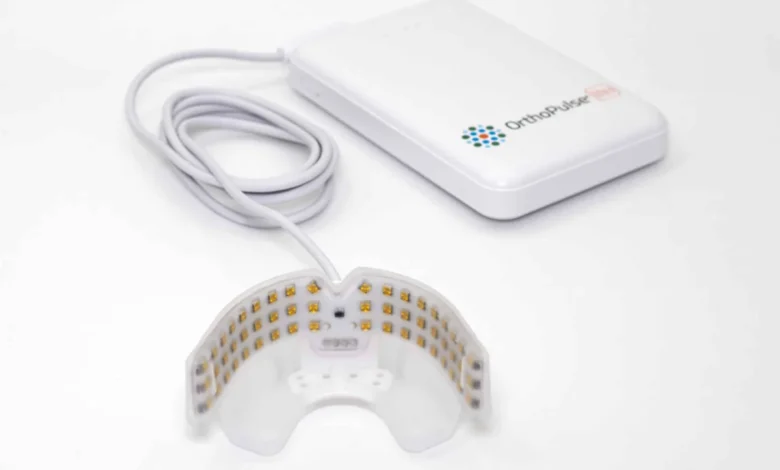
In the context of orthodontics, this translates to an acceleration of the bone remodeling cycle. By stimulating osteoblasts and osteoclasts, PBM therapy is believed to expedite the biological response to mechanical forces, allowing teeth to move more efficiently and predictably. Furthermore, the anti-inflammatory effects of PBM may contribute to reduced discomfort during treatment, an added benefit for patients. OrthoPulse is specifically engineered to deliver this therapeutic light effectively and safely, providing a non-invasive method to augment orthodontic treatment.
OrthoPulse: Technology and Patient Experience
OrthoPulse is an FDA-cleared and EU MDR-compliant medical device, underscoring its adherence to stringent safety and efficacy standards in both the United States and European markets. Its design emphasizes user-friendliness and patient compliance, requiring only 10 minutes of daily use. This short, convenient daily routine integrates seamlessly into a patient’s schedule, making it an accessible adjunct to their orthodontic care. The device’s portability and ease of use empower patients to actively participate in accelerating their treatment from the comfort of their homes.
The flexibility of OrthoPulse is another key advantage; it is compatible with both clear aligners and traditional fixed appliances, broadening its applicability across a wide spectrum of orthodontic cases. This versatility positions OrthoPulse as a universal enhancer for various treatment modalities, offering consistent benefits regardless of the primary orthodontic appliance chosen. For patients, the promise of shorter treatment times, fewer office visits, and a reduced likelihood of mid-course corrections significantly enhances the overall treatment experience, making the journey to a healthier, straighter smile more efficient and less intrusive.
Transforming Clear Aligner Therapy: A Growing Market
The orthodontic landscape has undergone a profound transformation over the past two decades, largely driven by the exponential growth and increasing sophistication of clear aligner therapy. Invisalign, specifically mentioned in the study, has become a household name, offering an aesthetically pleasing and often more comfortable alternative to traditional metal braces. However, even with the advancements in aligner technology, certain challenges persist, including the variability in patient compliance, the potential for "tracking issues" where aligners don’t fit perfectly, and the frequent need for refinements that can extend treatment durations beyond initial estimates.
These preliminary findings from Biolux Technology’s study suggest that OrthoPulse directly addresses some of these inherent challenges. By accelerating tooth movement and improving predictability, the device offers a powerful tool to overcome common hurdles in aligner therapy. This innovation could solidify the advantages of clear aligners while mitigating their drawbacks, making them an even more attractive option for a broader patient demographic. The global market for orthodontics continues to expand, driven by increasing aesthetic awareness and advancements in dental technology. Within this growing market, solutions that promise greater efficiency and predictability are poised for significant adoption.
Perspectives from the Clinical Lead and Industry
Dr. Bella Shen Garnett, the lead orthodontist conducting the study, articulated the practical implications of these findings for clinicians. "One of the biggest challenges in aligner therapy is ensuring that treatment progresses as planned," Dr. Shen Garnett stated in a release. "These findings suggest that OrthoPulse may help reduce the need for refinements while improving overall treatment efficiency and the patient experience." Her statement underscores the clinical utility of OrthoPulse in addressing common frustrations experienced by both practitioners and patients, leading to more predictable outcomes and enhanced patient satisfaction.
From Biolux Technology’s perspective, these preliminary results are a validation of their commitment to innovation in orthodontic care. While no direct quote from a company executive was provided in the original release, it can be logically inferred that a spokesperson would express immense satisfaction and optimism. "We are incredibly encouraged by these initial results, which powerfully demonstrate OrthoPulse’s potential to revolutionize orthodontic treatment," a company representative might state. "Our mission at Biolux Technology is to provide evidence-based solutions that enhance both clinical outcomes and the patient journey. This preliminary data is a strong testament to the transformative power of near-infrared photobiomodulation, and we eagerly anticipate the broader findings from our ongoing study."
Industry analysts are also likely to view these results with significant interest. Technologies that streamline treatment and improve patient compliance in the lucrative clear aligner market are often met with enthusiasm. "The orthodontic sector is constantly seeking innovations that can differentiate practices and improve the patient experience," notes a hypothetical industry analyst. "If these preliminary findings are borne out in larger studies, devices like OrthoPulse could become standard adjuncts, offering a competitive edge to practices and driving further market growth for complementary technologies."
Broader Implications and the Future of Orthodontics
The implications of Biolux Technology’s preliminary findings extend far beyond individual cases. For clinical practice, the integration of OrthoPulse could lead to standardized protocols that consistently deliver faster and more predictable results. This could free up valuable chair time for orthodontists, allowing them to manage more patients or dedicate more time to complex cases. The enhanced predictability could also reduce the stress associated with managing patient expectations and dealing with unforeseen treatment deviations.
From a patient perspective, the benefits are profound. A shorter treatment duration means less time spent with aligners, fewer adjustments to lifestyle, and a quicker realization of their desired smile. Fewer office visits mean less time away from work or school, and fewer refinements translate into less frustration and potentially lower overall costs. The prospect of completing treatment without any refinements, as seen in 15% of OrthoPulse cases, represents the gold standard in orthodontic efficiency and patient satisfaction.
This development also highlights a broader trend in healthcare: the integration of adjunctive technologies to optimize primary treatments. Just as pharmaceuticals enhance surgical outcomes, devices like OrthoPulse are designed to complement and accelerate the effectiveness of mechanical orthodontic forces. This interdisciplinary approach—combining biomechanics with biostimulation—represents the cutting edge of modern orthodontics.
Looking Ahead: The Ongoing Study and Research Pathways
It is important to emphasize that these are preliminary data from an ongoing clinical study. While the initial findings are compelling, the scientific community will look forward to the expansion of this research. Future phases of the study are expected to include a larger cohort of patients, potentially encompassing a wider range of demographic groups and varying complexities of malocclusion. This expansion will provide more robust statistical power and further validate the observed benefits.
Further research avenues might include long-term stability studies to ensure that accelerated tooth movement does not compromise the longevity of the results. Investigations into the precise cellular and molecular mechanisms at play, perhaps through advanced imaging or biomarker analysis, could also provide deeper insights into how photobiomodulation optimally interacts with orthodontic forces. The potential for OrthoPulse to reduce patient discomfort during aligner changes, though not explicitly detailed in these preliminary findings, is another area ripe for exploration, given PBM’s known anti-inflammatory properties.
Biolux Technology’s announcement marks a significant milestone in the quest for more efficient and predictable orthodontic treatment. As the company continues its research, the orthodontic community eagerly awaits further data that could solidify OrthoPulse’s position as a transformative tool in the modern era of clear aligner therapy.
About Biolux Technology
Biolux Technology is dedicated to advancing orthodontic care through innovative, evidence-based solutions. The company focuses on developing medical devices that leverage cutting-edge science, such as photobiomodulation, to enhance treatment outcomes and improve the patient experience. With products like OrthoPulse, Biolux Technology aims to empower orthodontists with tools that drive efficiency, predictability, and superior results in their practices.