For over a decade, the dental and orthodontic industry operated under a predictable digital hierarchy: scale was the ultimate currency. Dental Service Organizations (DSOs), with their expansive networks of locations, effectively dominated search engine result pages (SERPs) through sheer financial force. By pooling resources, they could out-staff, out-market, and out-spend independent practices, creating a "winner-take-most" environment where visibility was often directly proportional to advertising expenditure. Independent practitioners were left to compete on the margins, relying on local reputation and personal relationships to survive in a landscape tilted heavily toward corporate scale.
However, the rapid integration of Generative AI into search engines—exemplified by Google’s AI Overviews, ChatGPT, and Perplexity—has fundamentally disrupted this paradigm. The current digital ecosystem no longer favors the massive fleet of standardized websites; it now prioritizes the agility of individual, highly authoritative, and contextually rich digital footprints.
The Shift from Keyword Ranking to Trust-Based Recommendation
The traditional SEO model, which dominated from 2010 to 2023, was predicated on the "Ten Blue Links" philosophy. In this framework, success was measured by a website’s ability to rank for specific high-volume keywords. A DSO could deploy a standardized template across fifty locations, swap out city names, and achieve broad, if shallow, visibility.
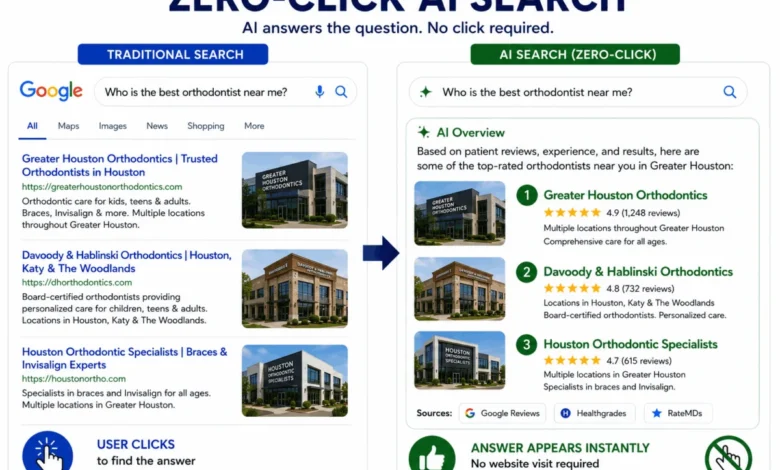
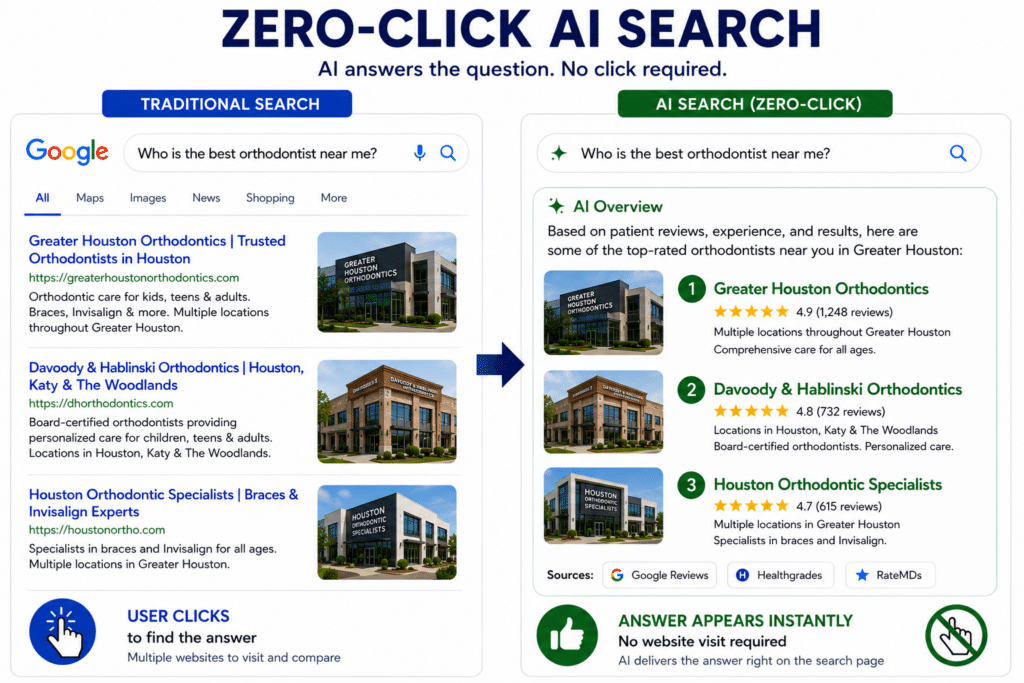
Today, the mechanism has changed. When a patient queries a generative search engine—such as asking, "Who is the best orthodontist in my area for Invisalign?"—the system is not performing a standard index lookup. Instead, it is synthesizing information to make a "trust decision." It is tasked with identifying which providers are the most credible, credentialed, and relevant to that specific user intent.

According to a comprehensive study released by BrightEdge in December 2025, the landscape has shifted drastically: 89% of healthcare-related keywords now trigger a Google AI Overview. This means that for the vast majority of clinical inquiries, the traditional list of links has been supplanted by an AI-generated summary. For the orthodontic industry, this is a sea change. Ranking high on a traditional list no longer guarantees that an AI will "mention" or recommend a practice. If an AI perceives a practice as generic or lacking in specific, verifiable expertise, it will simply bypass that site, effectively rendering a large marketing budget irrelevant if the underlying content strategy is not optimized for AI discovery.
The Vulnerability of the Fleet: Why Scale Can Be a Liability
The competitive advantage of the DSO has historically been standardization. By running the same software, website architecture, and content protocols across every location, DSOs could achieve rapid growth. However, this same uniformity is now becoming a structural liability.
Generative AI models are trained to prioritize E-E-A-T (Experience, Expertise, Authoritativeness, and Trustworthiness). When an AI analyzes a network of fifty websites that share near-identical service pages, thin doctor bios, and duplicate FAQs, it flags these as low-value, non-distinct sources. Essentially, the "fleet" model produces content that fails the authenticity test. Retrofitting a fleet of dozens of locations to meet modern AI standards is a massive, slow-moving administrative challenge.
In contrast, the independent practice functions as a single, agile boat. It possesses the ability to pivot its content strategy, deepen its written expertise, and optimize its structured data in real-time. Because it is not beholden to corporate bureaucracy or standardized templates, an independent practice can establish the level of granular, expert-led content that AI models currently favor.
Chronology of the Search Evolution
To understand the urgency of this transition, one must look at the timeline of the last few years:
- 2022: The emergence of ChatGPT signals the beginning of the "Generative Era," moving search from information retrieval to information synthesis.
- 2023: Search engines begin testing AI-integrated result pages, leading to the early "Zero-Click" era where users find answers without ever visiting a website.
- 2024: Industry data begins to show a decline in organic traffic for sites that rely on broad, low-effort keyword stuffing.
- 2025: The BrightEdge study confirms the near-total saturation of AI Overviews in healthcare search, marking the end of the traditional SEO dominance era.
- 2026-Present: The focus shifts entirely to Answer Engine Optimization (AEO) and Generative Engine Optimization (GEO).
The Role of Instrumentation: The KAL AI Growth System
In this new environment, the "navigation equipment" used by a practice determines its success. KaleidoscopeAI has developed the KAL AI Growth System specifically to address this technical gap. The system operates on the premise that visibility is a result of five distinct pillars: content depth, AI-optimized structure, third-party authority, local listing consistency, and schema markup (structured data).
The "AI Readiness Audit," a cornerstone of this approach, identifies gaps that prevent AI systems from trusting a practice. Data indicates that the average orthodontic practice currently scores below 50 out of 100 on these metrics, confirming that most of the industry is navigating the digital sea with outdated charts.
The strategy involves two core components:
- KAL Secure: A continuous monitoring system that watches for drift in rankings, listings, and site health, ensuring that the practice’s digital "crow’s nest" is always manned.
- KAL Amplify: A proactive content strategy that creates assets specifically designed for AEO and GEO. By shifting the focus from simply "ranking" to being "cited" by AI, practices move from competing for clicks to becoming the primary recommended authority in their local market.
Broader Implications for Healthcare Marketing
The democratization of search authority represents a significant threat to the status quo. If a smaller, independent practice can outrank a corporate entity by providing higher-quality, more relevant, and AI-optimized content, the primary justification for the DSO’s massive marketing spend begins to erode.
However, this does not mean independence is a guaranteed shortcut. The barrier to entry for AI visibility is high. It requires a disciplined approach to structured data and a commitment to producing content that answers patient questions directly and accurately. Practices that fail to invest in these fundamentals will find themselves invisible to the modern patient, regardless of their legacy search rankings.
Strategic Moves for the Current Quarter
For independent practices looking to capitalize on this window of opportunity, three tactical moves are essential:
- Audit for AI Trust: Use objective metrics to determine how AI currently perceives the practice. If the AI cannot accurately name the practice’s doctors or services, the foundation is flawed.
- Implement Structured Data: Move beyond basic website design to ensure that search engines can "read" the practice’s credentials, location, and services without ambiguity.
- Prioritize Direct-Answer Content: Shift content strategy from generic service pages to specific, question-based articles that directly address the concerns of patients in the local community.
The window of opportunity for early adoption is currently wide open, but it is narrowing as more practices catch on to the shift in search currents. The DSOs will eventually modernize, but the sheer size of their fleets makes them inherently slower to pivot. The advantage belongs to the practice that acts now—leveraging the agility of a single, well-navigated vessel to claim the authority that the new AI-driven landscape demands. As the industry moves further into the age of generative search, the ultimate winner will not be the one with the loudest megaphone, but the one whose expertise is most clearly, and most frequently, echoed by the AI itself.