Flat production and steady case starts mask a more complex picture—where overhead, staffing, and efficiency will determine who thrives next.

The orthodontic profession experienced a period of relative stability in 2025, marked by largely flat production and steady new patient case starts. However, beneath this veneer of calm, a comprehensive analysis of the 2025 Orthodontic Products/Levin Group Annual Practice Survey reveals a landscape increasingly shaped by rising overhead costs, persistent staffing challenges, and a growing divergence in profitability among practices. This intricate environment suggests that future success will hinge less on overall market growth and more on strategic operational management and efficiency.
The survey, conducted between February 25 and March 6, 2026, gathered data reflecting the full 2025 calendar year from a random sample of practicing orthodontists. The demographic breakdown indicated a profession still predominantly private practice-oriented, with 96% of respondents in some form of private practice and only 4% affiliated with Dental Service Organizations (DSOs) or Orthodontic Service Organizations (OSOs). The average age of participants was 56.4 years, with a gender split of 71% male, 27% female, and 2% preferring not to answer. A significant majority, 60%, reported operating solo practices, while 27% practiced with one other orthodontist, and 12% with three or more. This structure underscores orthodontics as a volume-based business where individual practitioners can manage substantial patient loads, driving high revenue potential.
Production Trends and Market Dynamics

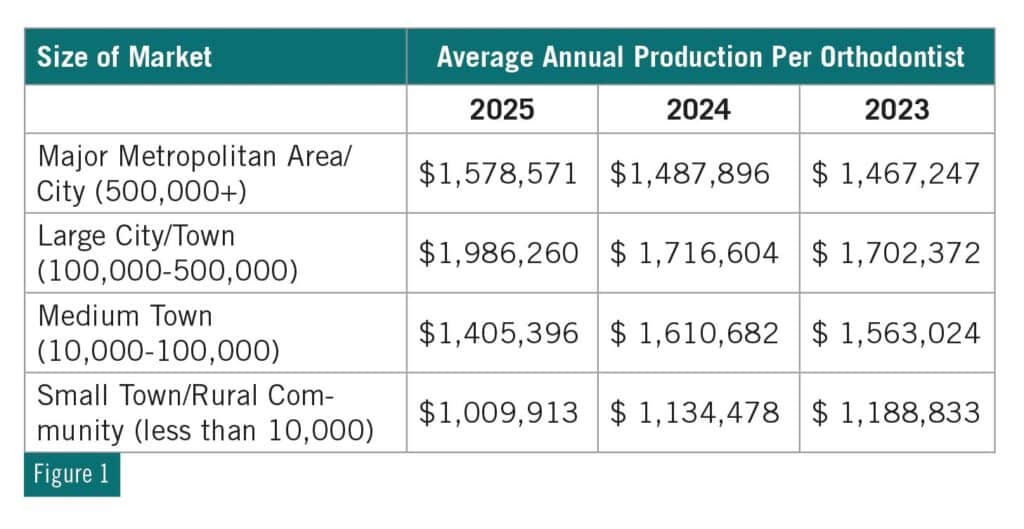
Average production per orthodontist in 2025 stood at $1,570,806, representing a marginal 1.1% decrease from the previous year. While this decline was slight nationwide, regional variations were notable. Data segmented by market size indicated that practices in large cities and towns generated the highest revenue. Conversely, orthodontists operating in small towns or rural communities (populations under 10,000) reported significantly lower production, approximately 33% less than their counterparts in larger markets. This disparity highlights the influence of population density and economic scale on practice performance, suggesting that geographic location remains a critical factor in revenue generation. The overall stability in production follows a challenging period during the pandemic, succeeded by a rebound year in 2024, positioning 2025 as a year of consolidation rather than significant growth or decline.
The Evolving Profitability Landscape
Despite the relative stability in production, the survey paints a more complex picture regarding profitability. The average orthodontic practice overhead percentage reached 56.5% in 2025, translating to an average profit of 43.5% of revenue. These figures represent a slight deterioration from 2024, with overhead increasing and profit margins narrowing. A concerning 51.4% of practices reported higher overhead in 2025 compared to the previous year, a trend that appears to be cementing itself in the profession. Only 10% of orthodontists managed to reduce their total overhead. This upward trajectory of operating costs has made overhead the second biggest challenge cited by practitioners.
The Levin Group, drawing from long-term observation, posits that orthodontic practices are fragmenting into distinct performance tiers. Historically, most practices saw annual increases in profitability. However, this is no longer the expected trajectory. In the future, the top 25% of practices are projected to achieve "phenomenal success," increasing income by at least 15% annually. The subsequent 25% will perform well, with income growth up to 15%. These "top half" practices are expected to become the "practice of choice" in their areas, sustaining growth throughout the doctor’s career. The remaining bottom half, however, could face significant challenges, struggling to maintain competitiveness, secure referrals, and attract new patient starts essential for sustained success. The 2025 profit data strongly supports this emerging "four buckets" perspective, underscoring the critical need for strategic management to avoid being relegated to the struggling lower tiers.
Patient Acquisition and Referral Dynamics
Patient volume data offered mixed signals. Total patient volume improved, with 74% of practices reporting the same or higher levels, a 10-percentage point increase from 2024. However, new patient volume remained largely stable, with 65% reporting consistent levels compared to 63% in the prior year. This suggests that while existing patient flow may be more robust, attracting new patients continues to be a primary concern.
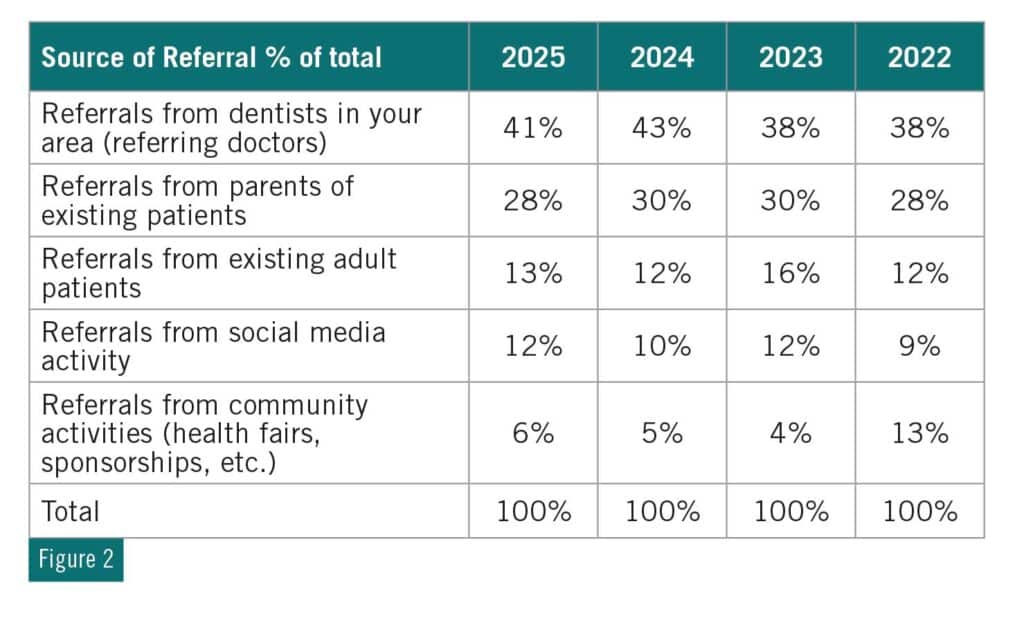
Referral sources, crucial for patient acquisition, showed general stability over a four-year period. General dentists remain the largest source of referrals, despite some also offering aligner services. The survey highlighted that referrals from general dentists and from parents of existing patients both experienced slight declines from 2024. This indicates that while traditional referral channels are still vital, they may not be as robust as in previous years.
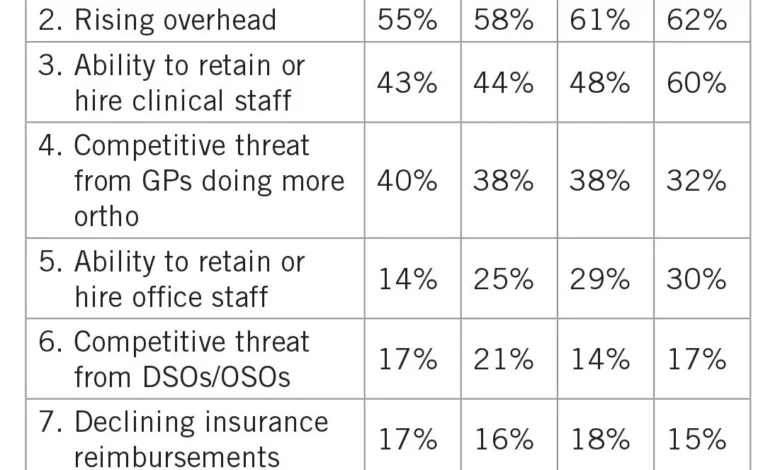
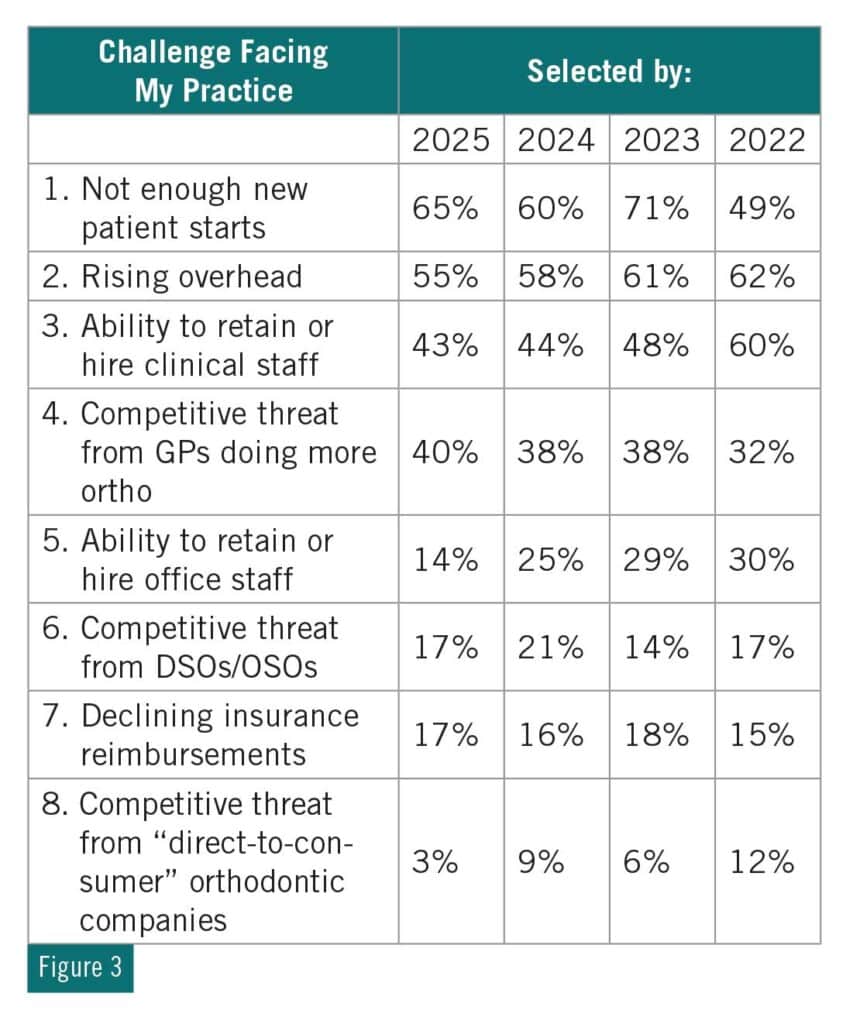
Unsurprisingly, "not enough new patient starts" emerged as the top challenge cited by orthodontists. This directly impacts revenue and collections, emphasizing the need for effective marketing strategies. The Levin Group recommends a multi-faceted referral marketing program targeting five key areas: patients, parents, referring doctors, social media, and the broader community. Successful practices are typically engaging in three or more of these areas, consistently including referring doctors. The role of a skilled Treatment Coordinator (TC) is also highlighted as crucial. With 85% of practices employing full-time TCs, the remaining 15% may be missing a significant opportunity to convert new patient consultations into treatment starts, directly impacting practice production and patient satisfaction.
Cost of Operations: Overhead and Staffing Crisis
The persistent increase in overhead is a major concern. The average overhead increase reported was 3.2%, surpassing the general U.S. inflation rate at the time of the survey. This "orthodontic inflation," driven primarily by escalating staffing costs, means practices are "swimming upstream" regarding profitability. Practice owners and office managers are urged to meticulously analyze overhead for cost reduction opportunities.
The staffing situation has evolved into a full-blown crisis within the dental sector, with orthodontics being no exception. Dr. Levin projects this crisis to last at least a decade, stemming from pandemic-related staff attrition and a growing desire for remote work incompatible with clinical roles. A staggering 74% of orthodontists believe there is a shortage of available orthodontic staff, with 57% actively seeking to hire for at least one vacant position. To cope, 81% of practices are now paying more total compensation per individual job position than in 2023, reflecting a 6.3% increase in staff compensation this year alone, with no practices reporting lower compensation.
Practices are employing various strategies to address this challenge:
- Increasing wages (84%)
- Offering more benefits (52%)
- Providing sign-on bonuses (40%)
- Investing in staff training (38%)
- Fostering a better team culture (33%)
- Implementing flexible hours (30%)
- Hiring remote staff (14%)
- Using temporary staff (11%)
- Increasing staff recognition (11%)
While these efforts help, the article notes that new technologies like artificial intelligence have not yet offset labor costs, indicating a significant financial strain on practices.
Technological Integration: Remote Monitoring and Teledentistry
The adoption of teledentistry and remote monitoring is rapidly expanding, with 30% of surveyed orthodontists now integrating these technologies into their practices—a significant increase from previous years. The primary uses include orthodontic checks (75%), retainer checks (55%), and emergencies (30%). Interestingly, the use of teledentistry for new patient consults or exams has steadily decreased since the pandemic, suggesting a strong preference for in-person initial interactions.
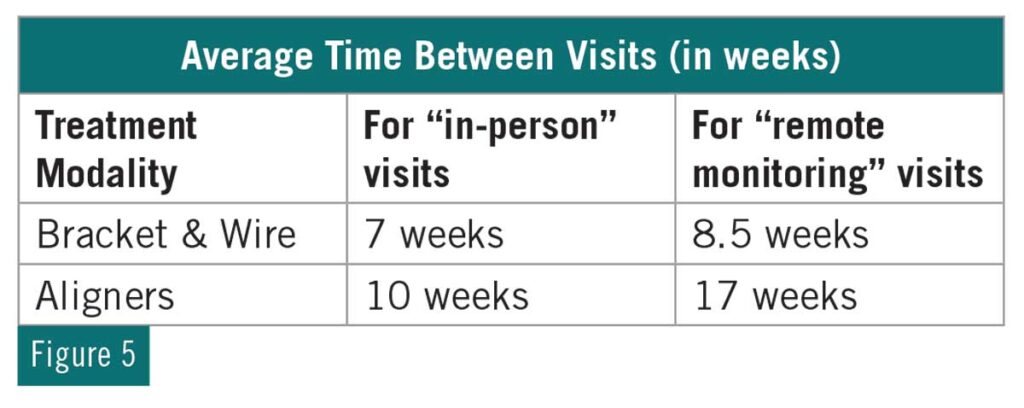
Remote monitoring offers a compelling economic case. Patients undergoing aligner treatment with remote monitoring visit the office significantly less frequently, averaging 17 weeks between appointments, compared to 10 weeks for aligner patients without remote monitoring, and 7 weeks for traditional bracket and wire patients. Even bracket and wire patients with remote monitoring extended their visit intervals to 8.5 weeks. This extended interval creates "excess chair time," which practices can leverage for increased patient volume, provided they have robust marketing strategies in place to fill the newly available slots. The most commonly used remote monitoring platforms reported were DentalMonitoring, LightForce, and InHand Health.
Case Types and Fee Structures
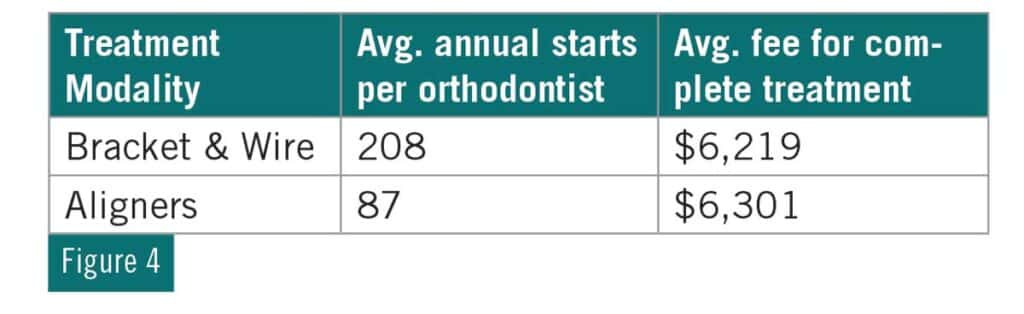
In 2025, the average annual starts per orthodontist included 208 for bracket and wire treatment and 87 for clear aligners, totaling 295 starts. This slight increase from the previous year indicates a positive sign of stability in treatment initiation.
However, fees remained largely stagnant, failing to offset the rising overhead. The average fee for bracket and wire treatment was $6,219, a marginal 1.6% increase from 2024. Clear aligner fees averaged $6,301, up by a mere 1.1% from the previous year. These changes are not statistically significant, meaning that despite increasing costs of operation, practices were largely unable to raise their prices to maintain profit margins. This further exacerbates the profitability challenge, especially for practices in the "bottom half" as described by the Levin Group.
Outlook and Recommendations for 2026
Despite the underlying challenges, orthodontists remain remarkably optimistic. A substantial 90% anticipate an increase in production in 2026, and a remarkable 94% are confident in maintaining a successful practice over the next five years. While this optimism is encouraging, Dr. Levin cautions that "hope is not a strategy." Sustained success will require proactive measures rather than simply expecting positive outcomes.
To thrive in the evolving landscape and position themselves among the top-performing practices, Dr. Levin offers three key recommendations for 2026:
- Implement highly efficient systems and properly train teams: Streamlining operations and ensuring staff proficiency can mitigate rising overhead and improve productivity.
- Maintain strong referral marketing: Given the challenge of "not enough new patient starts," a multi-pronged marketing approach is essential to attract and retain patients.
- Elevate Treatment Coordinator performance: Maximizing the conversion rate of new patient consultations is critical, and highly skilled TCs are instrumental in achieving this.
The departure of direct-to-consumer (D2C) orthodontic companies like Smile Direct Club in 2023 has significantly reduced competitive threats from that sector, which was once a major concern. This shift allows orthodontists to refocus on traditional competitive pressures and internal operational efficiencies.
In conclusion, while 2025 offered a period of stability for the orthodontic profession following a post-pandemic rebound, it also highlighted a growing chasm between practices that are strategically adapting and those that are struggling. The confluence of rising overhead, persistent staffing shortages, and stagnant fees necessitates a renewed focus on operational efficiency, robust patient acquisition strategies, and high-performing teams. For practices willing to embrace strategic change and proactive management, the optimistic outlook for 2026 and beyond is achievable. Conversely, those that fail to adapt risk falling into the struggling lower tiers of profitability, underscoring that the future success of orthodontic practices will undeniably be determined by how effectively they manage their overhead, staffing, and overall efficiency.